
Understand Where AI Governance Requirements Interact with MDR and IVDR
Preparing an AI-enabled Medical Device or IVD for market access?
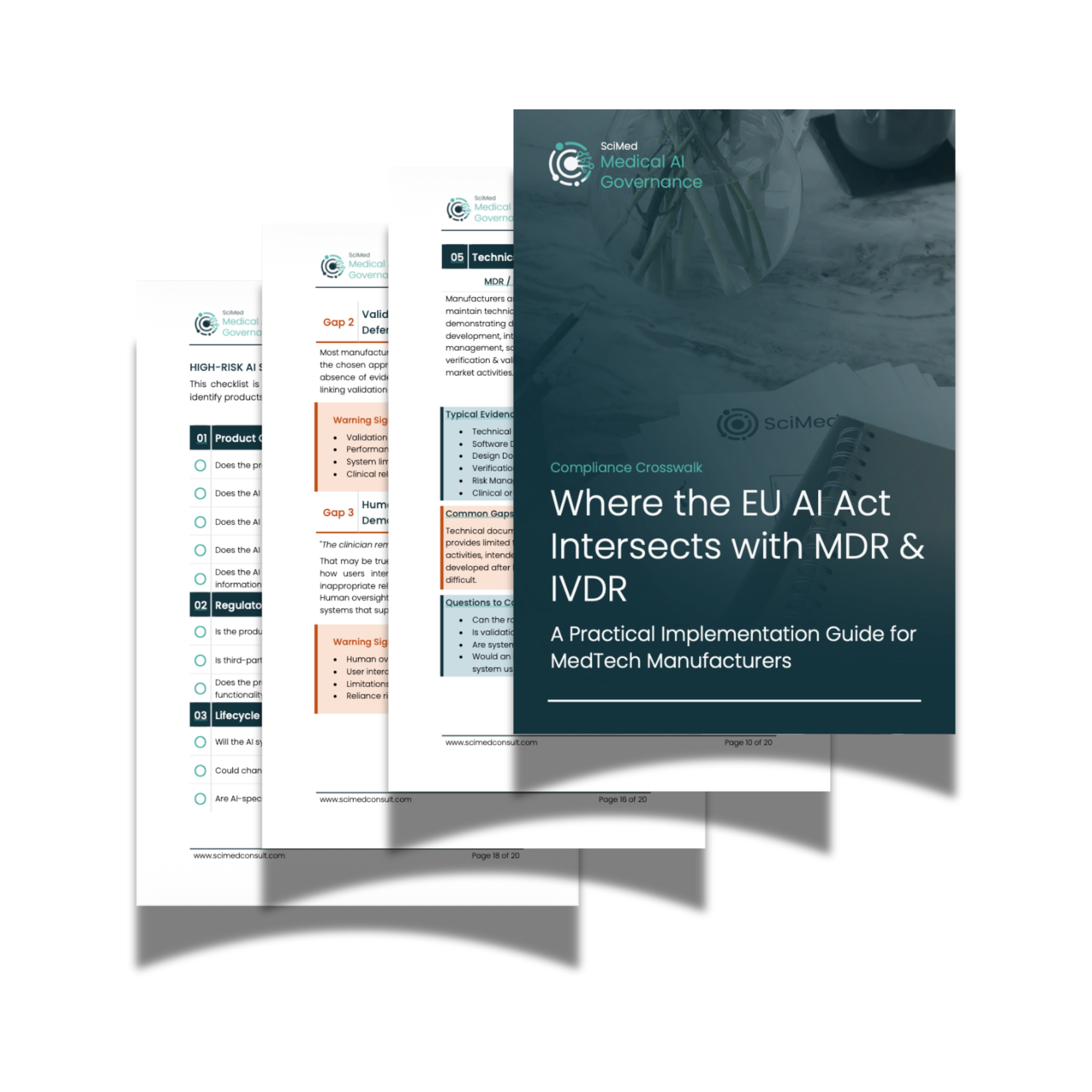
Download our practical Crosswalk to understand where MDR, IVDR, and emerging AI governance requirements overlap, where gaps commonly emerge, and what manufacturers should be considering now.
A practical guide to understanding how AI governance expectations interact with existing medical device and IVD regulatory obligations.
Built for MedTech Regulatory Decision-Makers
Focused on AI-Enabled Medical Devices and IVDs
Designed to Support Practical Compliance Planning
Most Manufacturers Understand MDR & IVDR…
The Challenge is Understanding what Changes when AI is Added.
Many organisations developing AI-enabled products already have established regulatory, quality, and risk management processes; the challenge is rarely starting from nothing.
The challenge is understanding how emerging AI compliance expectations interact with systems that already exist.
Requirements are often discussed separately. MDR and IVDR obligations sit in one set of guidance. AI compliance expectations appear in another. Technical, clinical, quality, and regulatory responsibilities often sit across multiple teams.
As a result, manufacturers are frequently left asking:
Which requirements are genuinely new?
Which existing systems already support compliance?
Where may additional governance or documentation be required?
What decisions made today could create remediation effort later?
The answers are not always obvious.
By the time compliance, validation, or documentation gaps become visible, significant work has often already been completed. This often results in a substantial cost, in time, resource, and organisational effort.
But, many of these challenges are avoidable. They simply need to be identified early enough.
A Practical Resource for Manufacturers of AI-Enabled Medical Devices and IVDs
The Crosswalk has been designed to help manufacturers understand how AI governance expectations interact with existing MDR and IVDR obligations in practice.
Rather than presenting regulations in isolation, it highlights where requirements intersect, where responsibilities overlap, and where future scrutiny may focus.
Inside the Crosswalk
✓ Areas where MDR, IVDR, and AI governance expectations overlap
✓ Compliance, governance, validation, and documentation considerations for AI-enabled products
✓ Common sources of future remediation effort
✓ Practical questions manufacturers should be asking now
✓ Considerations for both new and existing AI-enabled products
This is not intended to be a legal interpretation of the AI Act, it is a practical resource designed to support regulatory planning, governance discussions, and future compliance readiness.
Who This is For?
This Crosswalk is written for the people responsible for navigating regulatory complexity as AI becomes part of medical devices and IVDs. It is particularly relevant for:
Founders and CEOs of AI-enabled MedTech companies
Regulatory Affairs leaders
Quality and Compliance teams
Product and R&D leaders
Manufacturers assessing the impact of AI compliance requirements on existing products
Whether you are preparing technical documentation, evaluating future regulatory obligations, or reviewing an existing AI-enabled product, the Crosswalk provides a practical starting point.
Understanding Requirements is Not the Same as Understanding Their Impact
Most guidance explains what the requirements are, but far fewer resources explain what those requirements mean for organisations developing, maintaining, or commercialising AI-enabled medical devices and IVDs.
That distinction is why this Crosswalk exists.
Many manufacturers already have quality systems, risk management processes, validation activities, technical documentation, and post-market procedures in place. The challenge is understanding whether those existing systems adequately address emerging AI compliance expectations and where additional controls, evidence, or documentation may be required.
In our experience, the greatest risk is not misunderstanding a regulation, but rather it is making compliance, validation, documentation, or lifecycle decisions today without fully understanding how they may be viewed in future - resulting in often avoidable remediation effort later.
Additional documentation.
Additional evidence generation.
Additional review cycles.
Additional pressure on regulatory and commercial timelines.
We sometimes describe this as regulatory debt, not because it is a regulatory term, but because it reflects a pattern many organisations encounter as compliance expectations evolve.
The purpose of the Crosswalk is to help manufacturers identify these considerations early and support more informed decision-making before future compliance activities begin.
Identified Questions About Your AI Compliance?
You Are Not Alone
Many organisations reach this point and realise that understanding the regulations is only the first step.
Determining how compliance responsibilities should be structured, how AI performance should be justified, how technical documentation should evolve, and how future obligations may affect existing products can be significantly more challenging.
SciMed’s AI Compliance Assessment provides a structured review of governance, validation, documentation, and lifecycle readiness for AI-enabled medical devices and IVDs.
The assessment is designed to help manufacturers identify potential gaps, prioritise future activities, and build confidence in their regulatory position before scrutiny increases.
Structured findings and prioritised roadmap delivered within 10 working days.