

REGULATORY COMPLIANCE FOR AI-ENABLED MEDTECH PRODCUTS
Helping Manufacturers Navigate AI Compliance with Confidence
1,000+Regulatory submissions across the UK and EU
over 20
Notified Bodies & Approved Bodies Reviewed SciMed-supported documentation
11+ years
Supporting MedTech & IVD Clients Through Regulatory Change
Artificial intelligence is creating new opportunities across MedTech
From Software as a Medical Device (SaMD or MDSW) and clinical decision support systems to AI-enabled diagnostics and connected medical technologies, manufacturers are increasingly incorporating AI into products that support clinical and operational decision-making.
But innovation alone is not enough. As AI capabilities expand, so do regulatory expectations. Manufacturers must now navigate evolving AI regulations alongside existing MDR and IVDR obligations, while ensuring governance, evidence generation, lifecycle controls, and post-market activities remain fit for purpose.
The organisations that succeed are not simply those developing AI-enabled products, they are the organisations building regulatory strategy, governance, and compliance into those products from the beginning.
SciMed helps MedTech manufacturers achieve Regulatory Confidence when developing, deploying, and maintaining AI-enabled products.
Innovation Without Regulatory Debt
Many organisations approach AI as a technology challenge, but the greater challenge is often regulatory.
Questions that appear minor during development can become major obstacles during regulatory review, Notified Body assessment, market access activities, or post-market compliance.
Common examples include:
Unclear AI Act applicability,
Weak training and validation data governance,
Inadequate lifecycle controls,
Poorly defined update strategies,
Technical documentation gaps,
Incomplete post-market monitoring plans, or
Unclear accountability for future model changes
These issues rarely cause immediate failure, rather, they create regulatory debt; ocumentation must be revisited. Evidence must be recreated. Technical files require remediation. Product teams are forced to revisit decisions that could have been addressed much earlier.
The most effective compliance strategy is therefore not remediation, it is prevention.
Our role is to help manufacturers identify and address AI-related compliance risks before they become costly regulatory problems.
The Regulatory Landscape for AI-Enabled Products
AI introduces new considerations throughout the product lifecycle, and manufacturers must now address requirements that extend beyond traditional software and device development activities.
Data Governance and Evidence Generation
The performance of AI-enabled products depends heavily on the quality of the data used throughout development and validation.
Manufacturers increasingly need to demonstrate:
Dataset provenance
Representativeness
Annotation controls
Validation independence
Bias mitigation approaches
Ongoing governance mechanisms
Strong data governance is rapidly becoming a regulatory expectation rather than a competitive advantage.
Technical Documentation
The performance of AI-enabled products depends heavily on the quality of the data used throughout development and validation.
Manufacturers increasingly need to demonstrate:
Dataset provenance
Representativeness
Annotation controls
Validation independence
Bias mitigation approaches
Ongoing governance mechanisms
Strong data governance is rapidly becoming a regulatory expectation rather than a competitive advantage.
AI Act Applicability and Classification
Understanding whether AI-specific regulations apply is often the starting point for an effective compliance strategy.
Manufacturers need clarity on:
AI Act applicability
High-risk classification
Regulatory obligations
Conformity assessment implications
Documentation expectations
Without this clarity, development programmes can quickly become misaligned with future compliance requirements.
Lifecycle Governance & Change Control
Unlike many traditional technologies, AI systems may evolve throughout their lifecycle.
Manufacturers must establish appropriate controls for:
Model updates
Retraining activities
Performance monitoring
Change management
Verification and validation activities
Without a structured lifecycle strategy, future modifications can introduce significant regulatory uncertainty.
Post-Market Monitoring
Regulatory obligations continue after market release.
Manufacturers must establish mechanisms for monitoring:
Real-world performance
Performance drift
User feedback
Adverse events
Emerging risks
Corrective actions
Post-market monitoring is often where AI governance becomes operational reality.
The SciMed Medical AI Governance Framework
Our approach is built around the SciMed Medical AI Governance Framework.
This framework helps manufacturers establish Regulatory Confidence throughout the product lifecycle.
Govern
Define ownership, accountability, and governance responsibilities.
Assess
Understand regulatory obligations, risks, and applicability.
Validate
Generate evidence demonstrating performance and reliability.
Control
Embed governance into lifecycle management and quality systems.
Monitor
Maintain oversight throughout the product lifecycle.
The outcome is not simply compliance, it is confidence that innovation can progress without creating future regulatory debt.
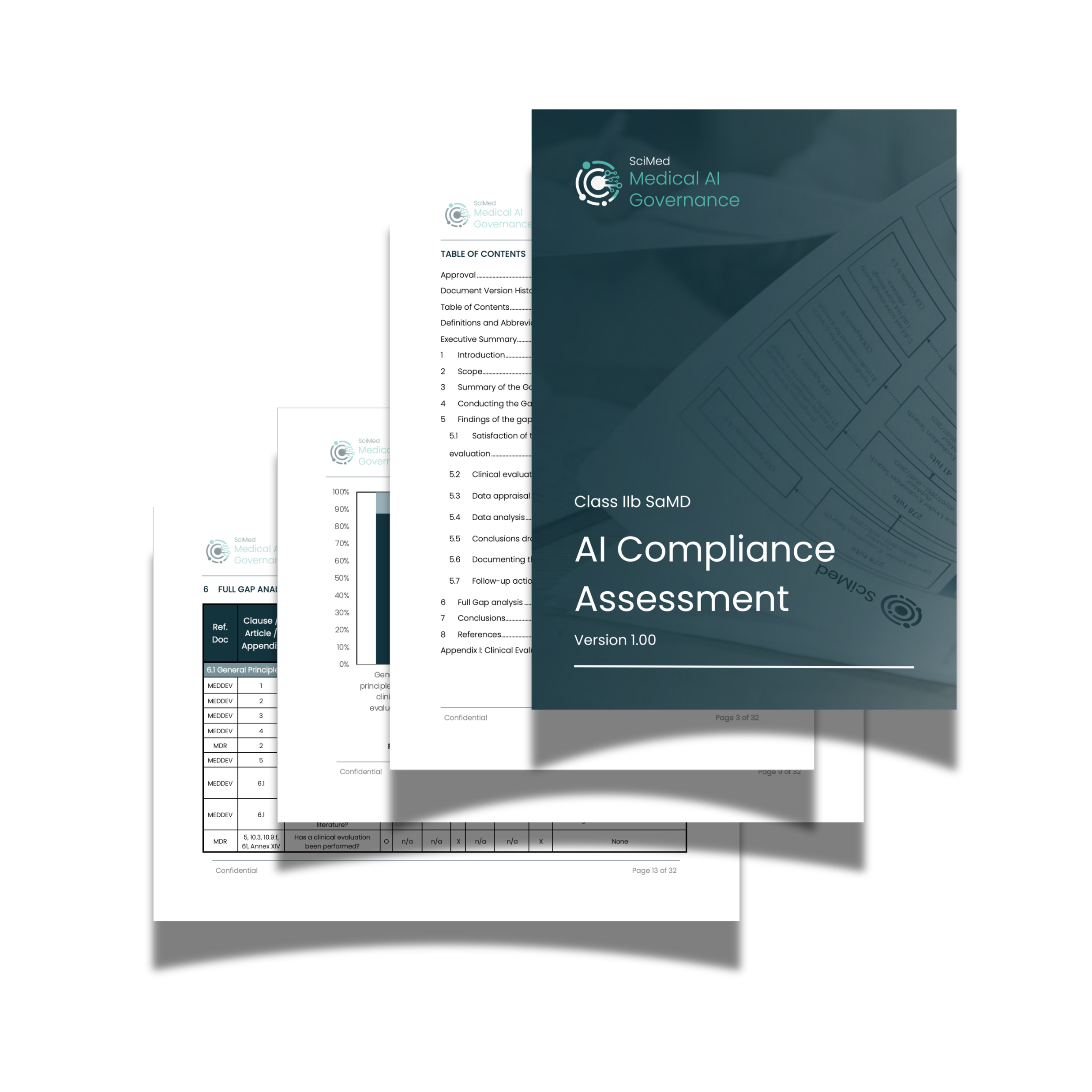
AI Compliance Assessment
Understand Your Current Position Before Problems Become Remediation Projects
The AI Compliance Assessment is designed for manufacturers who need clarity on regulatory obligations, compliance risks, and next steps.
We evaluate:
✅ AI Act applicability,
✅ Regulatory obligations,
✅ Governance maturity,
✅ Documentation readiness,
✅ Lifecycle controls,
✅ Data governance approaches, and
✅ Post-market preparedness.
Deliverables
AI Compliance Assessment Report
An independent review of regulatory obligations, risks, and compliance status.
Compliance Obligations Matrix
Mapping requirements, current status, identified gaps, and recommended actions.
Prioritised Roadmap
90-day, 6-month, and 12-month recommendations.
Typical Outcomes
Clarity on AI-related obligations
Identification of compliance gaps
Reduced regulatory uncertainty
Improved development planning
Prioritised implementation activities
Our Medical AI Governance Services
Whether you are developing a new AI-enabled medical device, preparing for conformity assessment, or strengthening an existing quality system, SciMed provides practical regulatory support throughout the AI product lifecycle.
Our services are designed to help manufacturers understand regulatory obligations, implement proportionate governance, and build documentation capable of withstanding regulatory scrutiny.
-
Determine whether your product falls within the scope of the AI Act, understand its regulatory classification, and identify the obligations that apply before significant development decisions are made.
-
Build a practical regulatory roadmap showing how AI Act requirements integrate with MDR, IVDR and existing quality management activities.
-
An independent assessment of your current AI governance, documentation and regulatory readiness.
Identify compliance gaps, prioritise implementation activities and receive a structured roadmap for achieving AI compliance.
-
Develop governance frameworks covering model updates, validation activities, change management and ongoing lifecycle control.
-
Evaluate dataset governance, validation strategies, bias management approaches and evidence supporting AI performance throughout development.
-
Strengthen technical documentation supporting AI-enabled products, ensuring governance arrangements, evidence generation and regulatory expectations are appropriately documented.
-
Develop practical post-market monitoring processes capable of supporting AI-enabled technologies throughout commercial deployment, including performance monitoring, feedback collection and continuous improvement.
Who Are These Services For?
These services are designed for:
Manufacturers developing AI-enabled products under MDR or IVDR,
Digital Health Companies integrating AI into software-driven healthcare products,
Product and Innovation Teams seeking to incorporate AI while maintaining a clear regulatory pathway,
Regulatory and Quality Leaders responsible for ensuring AI innovation remains aligned with compliance obligations, and
Manufacturers with software products who are unsure if the AI Act applies to them.
SciMed’s Medical AI Governance services are for you if…
You're likely to benefit from SciMed's services if you recognise your organisation here:
You're developing an AI-enabled medical device or IVD...
...and want confidence that your regulatory strategy will stand up to future AI Act, MDR and IVDR scrutiny.
You're unsure how the AI Act affects your product...
...and need practical guidance on applicability, obligations and conformity assessment requirements.
You're introducing AI into an existing product...
...and need to understand how design changes, validation and documentation should be managed.
You need AI governance that works in practice...
...not simply policies on paper, but governance frameworks that support development, quality and regulatory compliance.
You're preparing technical documentation for regulatory review...
...and want evidence, governance and documentation that clearly demonstrate control over your AI system.
You're looking for practical regulatory advice rather than theoretical AI commentary...
...and value evidence-based recommendations that can be implemented within real MedTech development programmes.
You want a long-term regulatory partner...
...who can support your organisation as AI regulations, products and governance requirements continue to evolve.
If you're looking for someone to simply interpret legislation or confirm the answer you were already hoping for, we're probably not the right fit.
Our clients value independent regulatory judgement, scientific rigour and practical implementation that stands up to regulatory scrutiny.
Medical AI Insights & Resources
A practical guide to understanding how emerging AI obligations interact with existing MedTech regulations.
Explore practical guidance on Medical AI Governance, AI-enabled products, and AI-enabled regulatory operations.
Featured Article
Does the EU AI Act Apply to Your Medical Device?
What you manufacturers of AI-enabled medical devices should understand about the EU AI Act
Featured Resource:
EU AI Act × MDR/IVDR Compliance Crosswalk
FREQUENTLY ASKED QUESTIONS
-
Not necessarily. Applicability depends on intended use, classification, and regulatory pathway.
-
An AI Compliance Assessment evaluates regulatory obligations, governance maturity, documentation readiness, and compliance risks relating to an AI-enabled product.
-
AI lifecycle governance refers to the controls used to manage development, validation, deployment, monitoring, updates, and change management throughout the life of an AI-enabled product.
-
Regulators increasingly expect manufacturers to demonstrate that training and validation datasets are appropriate, representative, controlled, and suitable for their intended purpose.
-
The earlier compliance considerations are integrated into development activities, the easier it becomes to avoid future remediation, documentation gaps, and regulatory delays.

Build AI-Enabled Products With Regulatory Confidence
Whether you are assessing AI Act applicability, developing lifecycle governance controls, strengthening technical documentation, or preparing for regulatory review, the first step is understanding your current position.
Identify Risks Early. Build Compliance Strategically. Innovate With Confidence.