

IS YOUR PMS SYSTEM AUDIT-READY UNDER MDR?
Identify gaps in your post-market surveillance before your Notified Body finds them.
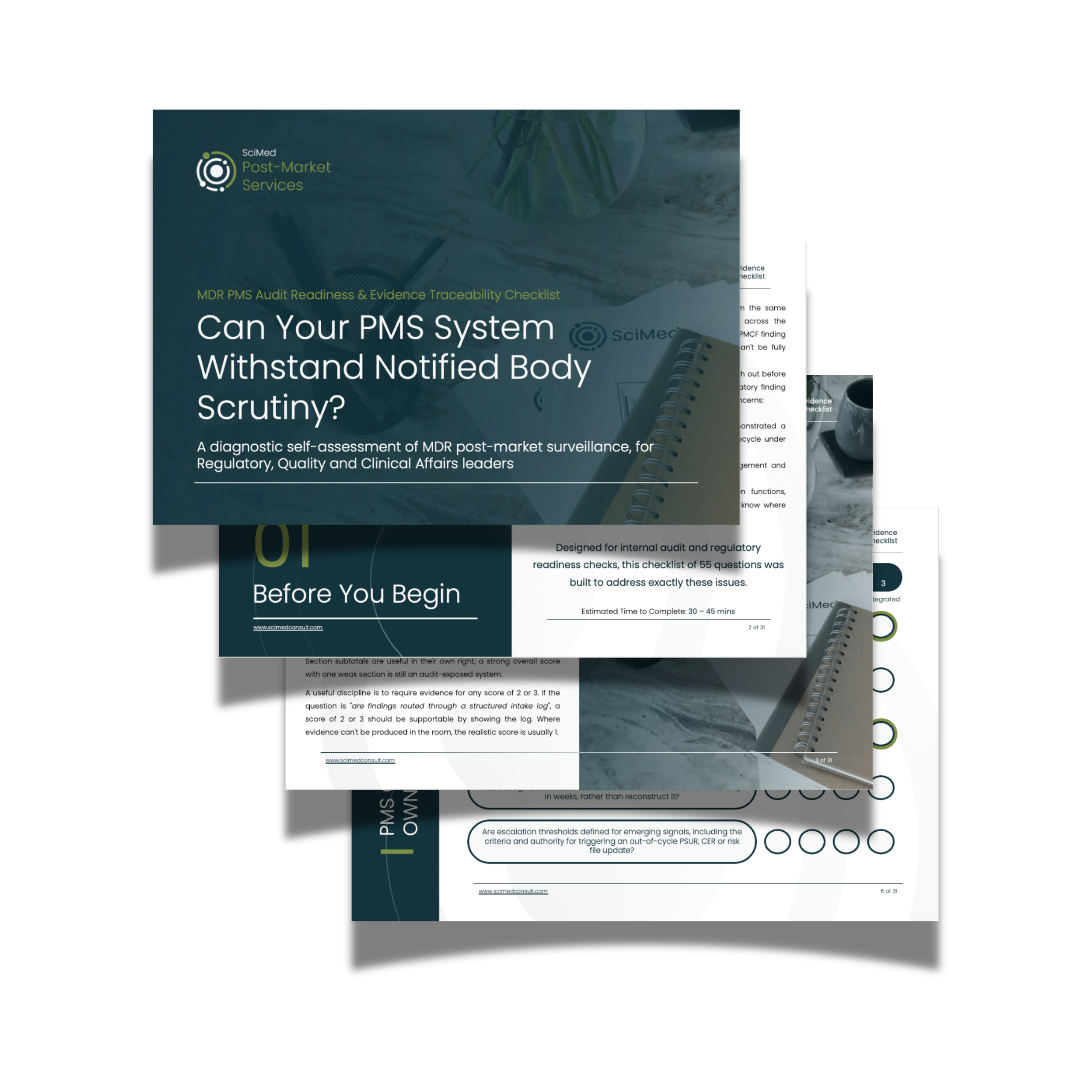
A practical, audit-aligned checklist to assess whether your PMS, PMCF, CER, Risk Management and PSUR hold together as a defensible evidence system.
Built for Regulatory, Quality and Clinical Affairs Leaders
Aligned to MDR Articles 83-86, Annex III and Current Notified Body Expectations
Focused on the Evidence Thread Notified Bodies Actually Trace
Most PMS Problems Are Hidden Until the System is Pulled Apart
Manufacturers who struggle with MDR post-market surveillance rarely struggle because they haven't built a system. They've built one, and often a fairly mature one, with a PMS Plan in place, a PSUR cycle running, and PMCF and Risk Management feeding the CER on the expected schedule. The harder question, and the one most teams find difficult to answer for themselves, is whether all those moving parts actually integrate, or whether they only look integrated until an external reviewer pulls on the thread.
The problem is more subtle.
PMS findings flow into one document and not another. The PMCF outputs feeding the CER don't always match the issues being tracked in the Risk File. The PSUR reads as a standalone deliverable rather than as the apex of a coherent evidence cycle. The state-of-the-art picture in the CER no longer reflects what PMS is actually surfacing.
Each weakness, on its own, looks manageable. The cost surfaces when a Notified Body reviewer pulls the thread between PMS, PMCF, CER, Risk Management and PSUR and finds that the joins don't hold.
This is the pattern we hear from regulatory teams across MedTech: confidence in the individual documents, uncertainty about whether they form a system, and quiet doubt that the next audit will go as smoothly as the last.
Audit observations, delayed PSUR sign-off, and avoidable rework are the result. Most are preventable, but only if the gaps surface before the audit does.
A Checklist Built Around How Notified Bodies Actually Review Post-Market Surveillance
It covers the full scope of MDR post-market surveillance as it's actually examined by Notified Bodies.
Identify gaps before they become Notified Body findings.
Assess whether your PMS system is genuinely audit-defensible, not just compliant on paper.
Focus your attention on the integration points most likely to trigger concern, and prioritise your next actions based on regulatory risk.
You'll assess whether your PMS Plan sets out a credible, proportionate strategy under Annex III. You'll review how your PMS data sources, frequency, and methodology hold up against current expectations. Your PMCF Plan and Evaluation Report will be examined for integration into the CER, and your Risk Management File checked for genuine post-market feedback rather than documentation alone. PSUR coherence, SSCP traceability, and the evidence thread between PMS, PMCF, CER, Risk and PSUR are all addressed.
This is not a generic MDR checklist. It's structured to reflect how PMS is actually reviewed in audit, not simply how guidance documents describe it.
Who This Is For?
This checklist is written for the people who carry the weight of post-market compliance day to day.
If you're a QA/RA Director responsible for the PMS system across a product portfolio, a Regulatory or Clinical Affairs Manager preparing for a PSUR submission or Notified Body surveillance audit, or a Quality Lead overseeing PMS, PMCF and Risk Management with limited internal capacity, this resource is designed for your working reality.
It's particularly relevant if you're preparing for a Notified Body surveillance audit, approaching a PSUR submission cycle, uncertain whether your PMS outputs are integrating properly with PMCF, CER and Risk Management, or managing post-market surveillance across a growing portfolio without a large dedicated team behind you.
Having a PMS Plan Is Not the Same as Having a PMS System
Most guidance tells you what a PMS Plan should contain. It doesn't tell you whether the system that plan describes will hold together when a Notified Body reviewer traces the evidence thread.
That distinction is what this checklist is built around.
Rather than confirming that documents exist, it asks whether they integrate. It focuses on the structural weaknesses that carry the highest audit risk, not the lower-impact details that can be addressed later. It's designed to give you decision-making clarity, not more guidance to interpret.
It's designed to help you answer a direct question:
Would your evidence thread hold under Notified Body challenge?
Found Gaps? You Are Not Alone
Many manufacturers reach this point and realise their PMS system needs more than a document refresh. Building genuine PMS-PMCF-CER-Risk-PSUR integration, maintaining audit-defensible evidence over time, and demonstrating proportionate state-of-the-art monitoring are challenges that stretch even well-resourced regulatory teams.
SciMed offers a focused PMS Gap Analysis Consultation aligned to current Notified Body expectations. We work with you to identify the structural weaknesses most likely to surface in audit, give you a proportionate remediation pathway, and an honest view on whether a deeper engagement is warranted.
We will discuss your PMS position and identify critical risks within a focused 30-minute session.