

IS YOUR CLINICAL EVALUATION AUDIT-READY UNDER MDR?
Identify gaps in your Clinical Evaluation before your Notified Body finds them.
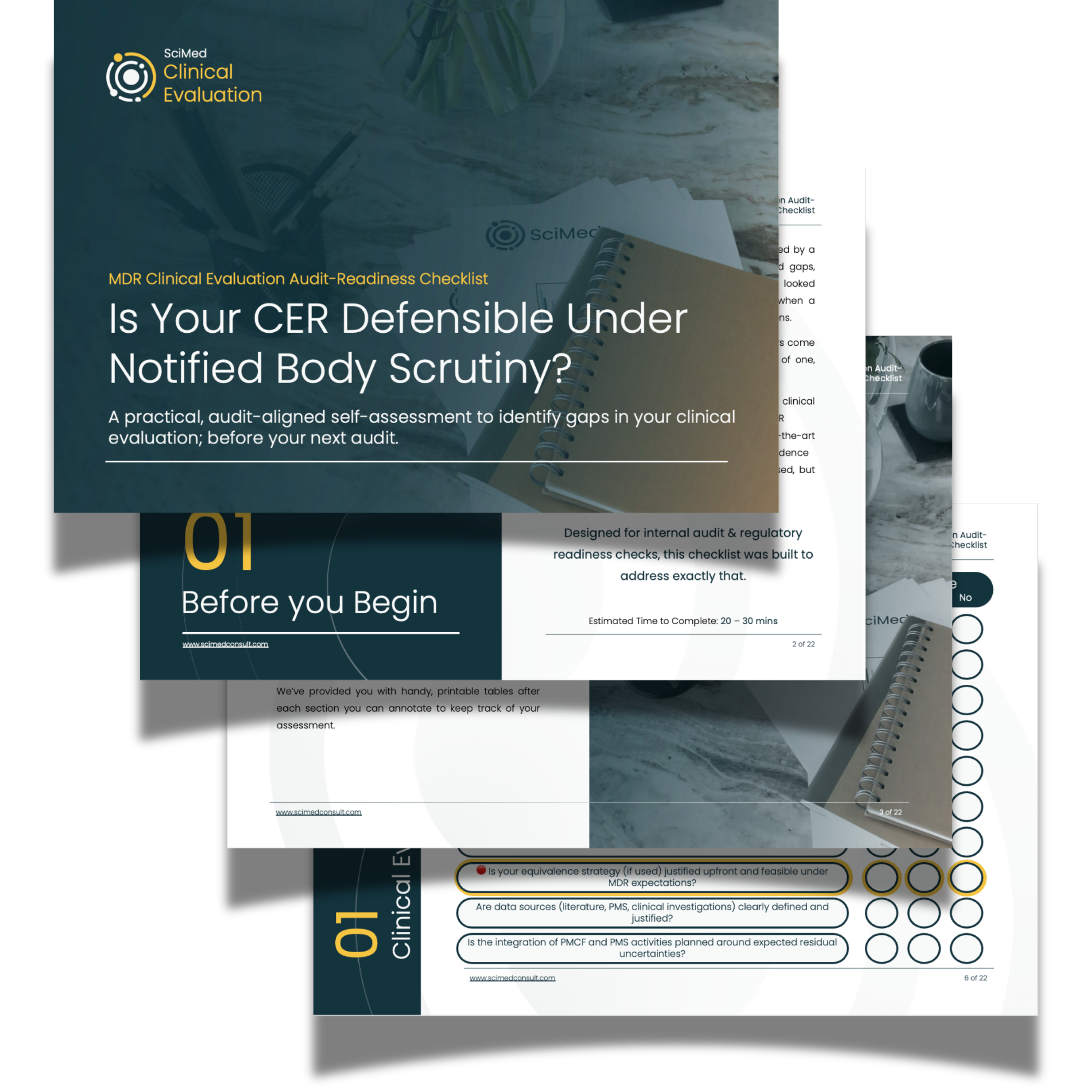
A practical, audit-aligned checklist to assess whether your CER is defensible under real Notified Body scrutiny.
Built for MedTech Regulatory Decision-Makers
Aligned to MDR Annex XIV and Current Notified Body Expectations
Focused on Real-World Audit Defensibility
Most Clinical Evaluation Problems Are Hidden Until It's Too Late
The manufacturers who struggle most with MDR compliance are rarely those who have not tried. The effort is there. The documentation exists. The CER has been written, reviewed, and signed off.
The problem is more subtle.
Expectations across MDR guidance are not always clear. Clinical evidence that felt sufficient at the time of writing does not always hold up when a Notified Body examiner starts asking questions. Assumptions about equivalence, state-of-the-art, and PMCF integration get embedded into documents without anyone realising they may not survive scrutiny.
By the time those gaps surface, you are already in review. The cost, in time, in resource, and in confidence, is significant.
This is the pattern we hear from regulatory teams across MedTech: uncertainty about what "sufficient clinical evidence" actually means under MDR, difficulty constructing a defensible equivalence justification, and the ongoing pressure to keep CER documentation audit-ready with limited internal capacity.
Audit findings, delays, and avoidable rework are the result. None of them are inevitable, but most are preventable.
A Checklist Built Around How Notified Bodies Actually Review Clinical Evaluation
It covers the full scope of clinical evaluation as it is actually reviewed by Notified Bodies.
Identify gaps before they become Notified Body findings.
Assess whether your CER is genuinely defensible, not just complete.
Focus your attention on the areas most likely to trigger concern during a Notified Body audit, and prioritise your next actions based on regulatory risk.
You will assess whether your Clinical Evaluation Plan (CEP) sets out a credible, evidence-led strategy. You will review how your state-of-the-art analysis has been framed and documented. Your clinical data identification and appraisal methodology will be examined against current expectations, alongside your equivalence justification, and where the bar under MDR Annex XIV is higher than many teams anticipate.
The checklist also addresses CER conclusions, GSPR linkage, PMCF integration, and your overall audit readiness posture.
This is not a generic MDR checklist. It is structured to reflect how audits are actually conducted, not simply how guidance documents are interpreted.
Who This Is For?
This checklist is written for the people who carry the weight of MDR compliance day to day.
If you are a QA/RA Director responsible for maintaining clinical evidence across a product portfolio, a Regulatory Manager preparing for an upcoming audit or submission, or a Founder navigating CE marking for the first time under MDR, this resource is designed for your working reality.
It is particularly relevant if you are preparing for a Notified Body audit, updating an existing CER to meet MDR requirements, uncertain whether your current clinical evidence would survive challenge, or managing Clinical Evaluation without a large internal team behind you.
Completeness Is Not the Same as Defensibility
Most MDR guidance tells you what a Clinical Evaluation Report should contain. It does not tell you whether what you have written will hold up under scrutiny.
That distinction is what this checklist is built around.
Rather than confirming that sections exist, it asks whether those sections are defensible. It focuses on the failure points that carry the highest regulatory risk, not the lower-impact details that can be addressed later. It is designed to give you decision-making clarity, not more interpretation to work through.
It is designed to help you answer a direct question:
Would this withstand Notified Body challenge?
Found Gaps? You Are Not Alone
Many manufacturers reach this point and realise their clinical evidence strategy needs more than a document review. Defining sufficient clinical evidence under MDR, constructing a justifiable equivalence argument, and maintaining audit-ready documentation over time are challenges that stretch even well-resourced regulatory teams.
SciMed provides targeted Clinical Evaluation Gap Analysis aligned to real Notified Body expectations. We work with you to identify critical risks before they become findings, strengthen your clinical evidence strategy, and give your team a clear, defensible path forward.
Fixed fee. Written diagnostic in five working days. No scoping call required if you're ready to proceed.
We will review your current documentation and identify critical gaps within 5 working days.